Robots Are the Missing Workforce for Electrification
The electrify everything movement has a labor problem. We know what to build. We know how to build it. We just don't have enough humans to do it fast enough. Robots will change parts of that equation. But probably not the parts you think.
I spent five years building an electrification company. We electrified thousands of homes across three states. And the single biggest constraint we faced wasn't technology, wasn't customer demand, wasn't regulatory. It was people. Finding enough skilled HVAC technicians, electricians, and installers to keep up with the work.
The U.S. construction industry needs approximately 349,000 net new workers in 2026 and 456,000 in 2027, on top of normal hiring. The average HVAC tech is 55 years old. Demand for HVAC engineers is up 67% since 2022. Half of all construction employers report difficulty finding skilled applicants. Heat pumps outsold gas furnaces by 32% in 2024. The demand curve for electrification is exponential. The labor supply curve is flat to declining.
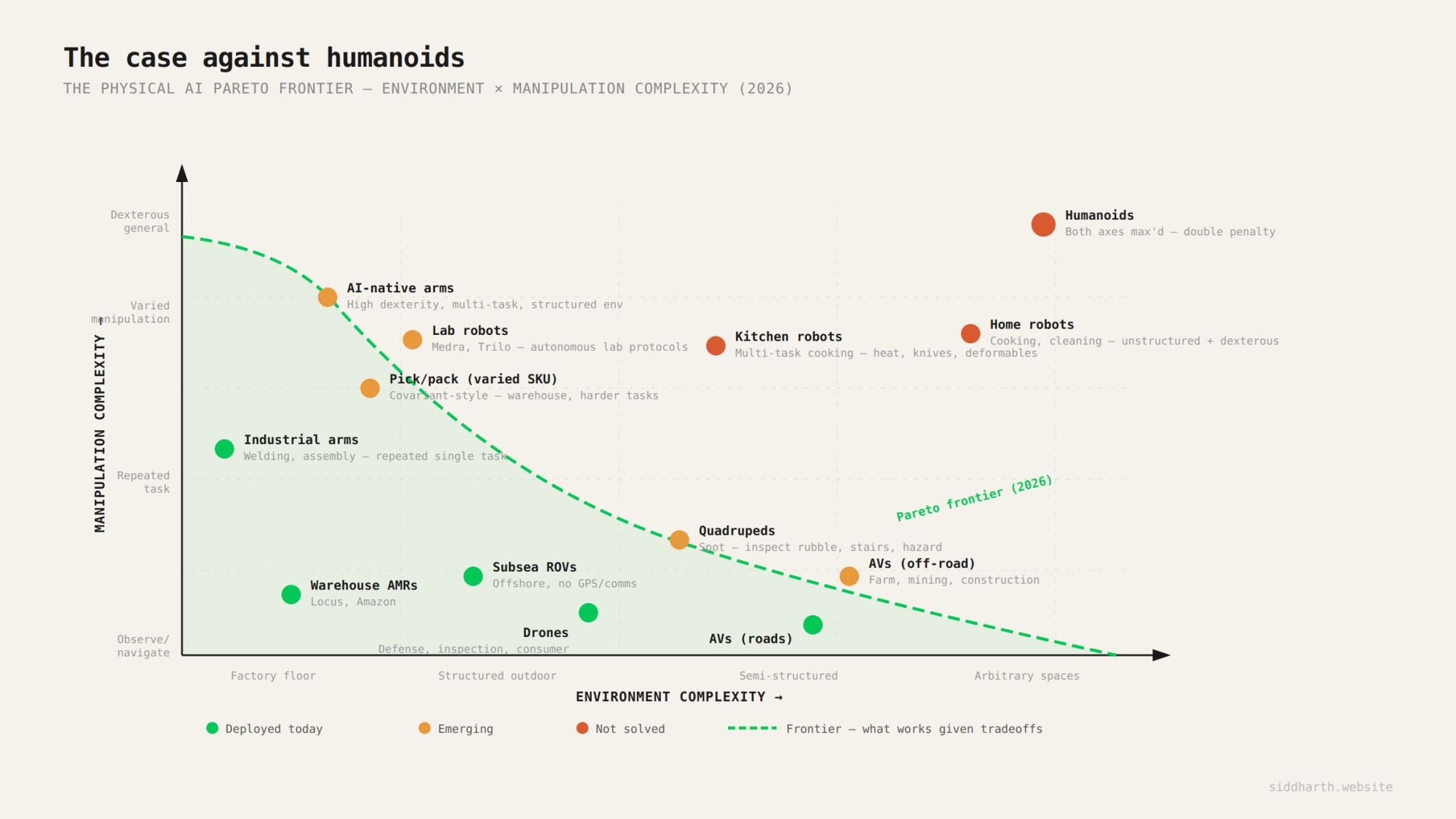
Look at the Pareto frontier image above. It maps where robotics works today (green), what's emerging (orange), and what's still unsolved (red). The robots grabbing headlines are the humanoids in the top-right corner. The robots actually accelerating electrification are in the bottom-left: solar installation robots, warehouse AMRs, and industrial arms operating in structured environments with repeated tasks.
Solar robots are already here, and they're fast
The most visible intersection of robots and electrification is utility-scale solar. And it's not theoretical. It's shipping.

Maximo (AES)
First AI-powered robot to complete a 100 MW utility-scale solar installation. Installs at nearly double the rate of traditional crews. Backed by NVIDIA Inception and AWS.

Terafab V2 (Terabase Energy)
Mobile "factory" deployed to solar construction sites. Pre-assembles panels onto torque tubes, then uses autonomous rovers for placement. A single line installs 20+ MW per week. Goal: a gigawatt in 10 weeks.

Lumi 4 (Luminous Robotics)
Boston-based. Nearly 600,000 panels at the 250 MW Goorambat East Solar Farm, most robot-installed. 60 modules per hour, estimated 30% cost reduction.
Why does solar work for robots now? A solar farm is "structured outdoor" with "repeated task" manipulation. Flat ground, consistent components, repetitive placement. The U.S. needs to build roughly 100 GW of solar per year by 2030. At that scale, the labor constraint becomes a binding constraint and robots become the only viable path.
By 2030, the majority of utility-scale solar in the U.S. will be installed with robotic assistance. The labor constraint is too severe and the technology is proven. Every major EPC will either develop or license robotic installation within five years.
Your HVAC installer's job is safe
Now for the honest part. Residential HVAC, plumbing, and electrical is where the electrification rubber meets the road: the heat pump install, the panel upgrade, the water heater swap. And this is where robots are essentially useless for the foreseeable future.
Installing a heat pump requires navigating a basement, running refrigerant lines through walls, connecting electrical circuits, mounting an outdoor unit on uneven ground, and commissioning a system with dozens of variables. That's "semi-structured" to "arbitrary spaces" on the environment axis and "varied manipulation" on the complexity axis. Orange-to-red territory on the Pareto frontier.
Nobody is sending a robot into your basement to install a Mitsubishi hyper-heating heat pump anytime soon. Every house is different. Every crawlspace is a unique horror show. Every line set run requires problem-solving that current robotics simply cannot do.
The same goes for plumbing and electrical. Replacing a gas water heater with a heat pump water heater means dealing with condensate drainage, expansion tanks, mixing valves, and rerouting plumbing in spaces never designed for it. Residential electrical work requires reading existing wiring, making judgment calls about load capacity, and physically working in tight junction boxes. These are "arbitrary spaces, varied manipulation" problems.
Tesla began production of its Optimus Gen 3 humanoid in January 2026. Musk projects a price of $20,000-$30,000. But on the Q4 2025 earnings call, he acknowledged the robots are not doing "useful work" yet. And robotics expert Rodney Brooks, co-founder of Roomba creator iRobot, has called humanoid general-purpose assistants "pure fantasy thinking."
Will heat pumps get cheaper? It's complicated.
Here's where I need to resist the temptation to make a clean prediction, because the forces acting on heat pump pricing are pushing in opposite directions simultaneously.
↑ Forces pushing prices up
Refrigerant transition. The shift from R-410A to R-454B and R-32 is the single biggest cost driver. R-454B is mildly flammable (A2L), requiring redesigned safety components, leak detection sensors, and new manufacturing. Honeywell announced a 42% surcharge on R-454B, on top of earlier 15% and 8% hikes. Equipment manufacturing costs are up 15-20% from A2L safety requirements alone.
Tariffs. Adding cost at every layer: raw materials, components, and finished equipment. R-454B supply can't be met domestically, so imports face additional tariff exposure.
Labor costs. 110,000+ unfilled technician positions. 5:2 retirement-to-replacement ratio. Wages rising 5-10% annually. A2L certification adds new training requirements.
Component competition. Heat pump manufacturers compete with Tesla, NVIDIA, and Apple for chips, sensors, and power electronics.
Rising efficiency floors. DOE SEER2 standards raised the minimum in 2023. The floor will rise again. Each step adds capability and cost.
↓ Forces pushing prices down
New entrants. Quilt makes the most efficient ductless mini-split on the market, with OTA software updates that unlocked 20% additional capacity for free. Gradient makes a 120V window heat pump that installs in under an hour with no electrician, no permits, no panel upgrade. 30,000 units going into NYC public housing.
Software-defined hardware. Quilt's approach (more sensors, continuous learning, OTA updates) means performance improves after purchase. That changes the value equation even if sticker price stays flat.
Manufacturing scale. Global installed heat pumps projected to grow from 180 million (2020) to 600 million by 2030. Scale drives unit economics down.
Simplified form factors. Gradient's installed cost is predicted to be 69% lower than mini-splits and 85% lower than VRFs. Different product, but it opens the market to buildings previously considered "un-electrifiable."
Incentive stacking. Federal, state, utility, and local incentives can still cover 30-60% of project costs in many markets.
My honest read: the sticker price of a traditional ducted or ductless heat pump will continue rising 5-10% annually for at least two to three more years. The refrigerant transition, tariffs, and labor costs are too strong. Lennox took 7-10% in early 2026 alone. A system that cost $7,000 in 2024 is running $10,000-$12,000 now.
But sticker price isn't the whole story.
Quilt's 3-zone system, built by veterans from Google, Apple, Nest, and Tesla, is the most efficient three-zone ductless system available (SEER2 of 25.3), maintaining 100% capacity down to -5°F. They have 65+ installation partners across 17 states and 6 Canadian provinces. They recently shipped an OTA update that unlocked 20% additional heating capacity to every unit in the field, for free. No service visit. That's not a heat pump. That's a platform.
Gradient's window units are deployed across 200+ residences in Boston, Detroit, and D.C. Their Nexus software turns distributed units into a building-wide coordinated system. One building cut energy consumption 25% overnight by setting temperature guardrails. They install in hours without electrical upgrades, targeting the millions of pre-1947 buildings that no traditional HVAC contractor would touch.
Equipment sticker prices will keep climbing, but the effective cost of electrification will fall. New form factors (Gradient, Quilt, Midea's compact indoor unit), simplified installation, software-defined performance, and creative incentive stacking will bring electrification within reach of buildings that were previously uneconomical. The price of a traditional Carrier or Lennox system won't save you. The market expanding around it will.
Where robotics actually changes the math
If robots aren't installing heat pumps and equipment isn't getting cheaper, where does robotics matter for electrify everything?
Solar cost and speed. Robotic installation drives down grid electricity costs, which sets the economic baseline that electrification competes against. Cheaper grid electricity makes heat pumps more cost-effective vs. gas, EV charging cheaper, and battery storage more attractive.
EV manufacturing. EVs are already the most robot-intensive products on the planet. As robotic manufacturing improves, EV costs come down. The battery, motor, and power electronics R&D flowing between EV and robotics programs feeds both directions.
Prefabrication. This is the bridge that matters most for residential electrification. Move complexity from the unstructured jobsite (where robots can't help) to the structured factory (where they can). Pre-built line sets, pre-wired assemblies, pre-configured controls.
The residential HVAC labor shortage will be partially offset not by robots in homes, but by prefabrication in factories and simplified product designs that require less skilled labor to install. The Gradient model (plug it in, done) and the Quilt model (fewer outdoor units, smarter software) point toward a future where the skill barrier for installation drops. Robots help in the factory. Simpler products help on the jobsite.
What I'd tell a friend
Don't wait for robots to make your install cheaper. That's not happening this decade for residential work. The labor shortage making it hard to get an installer on the phone? It's getting worse before anything makes it better. Book early.
Watch the new entrants. Quilt and Gradient are building heat pumps the way Tesla built cars: hardware that gets better through software. If your building is hard to reach with traditional HVAC, look at Gradient's window units. If you want the most efficient ductless system on the market, look at Quilt.
Don't assume prices will drop if you wait. Refrigerant transition, tariffs, and labor are all pushing equipment prices higher. Incentive programs change constantly. The best deal might be today, not next year.
The future is electric. Robots will accelerate the supply side: solar, manufacturing, grid. Humans will handle the last mile, your basement, your panel, your line set, for a long time. The bottleneck was never the technology. It's the people. We need more of them, and we need to make the work they do as simple as possible.
I write about energy, AI, and building companies. Subscribe for occasional updates.
Disclosure: Josh Lake is the co-founder and former CTO of Elephant Energy, a home electrification company, and the founder of Electrify Everything Now. He has a professional and financial interest in the electrification industry. This article reflects his honest assessment based on five years of operational experience. He has no financial relationship with any of the companies or products mentioned.